A Reply of Fifty Thousand Trees
April 12, 2000 — Windy
When I opened the door this morning, the window paper was rattling in the wind, and a hand’s depth of sand had piled up outside the threshold—as if someone had delivered a basket of fine flour to our house in the middle of the night. My mother cursed the sky. Auntie Qiaolan didn’t curse. She shouldered a bundle of sand willow saplings and headed straight into the dunes.
Life had been hard on this woman. The year she married into Jingwanzi, water had to be hauled from ten li away, and whenever the wind rose, a layer of sand settled at the bottom of every pot. She once said something stubborn that the whole village remembers: “I’d rather die of exhaustion planting trees than be bullied to death by sand.”
Today a rare visitor came to the dunes. High nose bridge, blue eyes, speaking a foreign language, wearing a jacket washed nearly white, following the township cadre in through the sand, one deep step after another. We learned later that he was a teacher from America, named Simon, come to see our Mu Us Desert through a teacher exchange program.
Teacher Simon walked up to Auntie Qiaolan’s trees. The sand willows planted the year before barely reached his knees, trembling in the wind. He crouched down, scooped up a handful of sand, and watched it drain away between his fingers until not a grain was left. Auntie Qiaolan crouched too, grabbed a handful, and it drained away as well. The two of them squatted there in the sand, neither saying a word, just watching the sand run through their fingers.
Ha. That foreigner was even more reluctant to leave than we were.
September 20, 2000
Something huge happened. Teacher Simon sent five thousand dollars from America.
Everyone in the village said: Qiaolan, build yourself a new house with this. She counted the money three times, didn’t take a single cent home, and traded it all for saplings at the nursery. Some laughed at her for being a fool: “That foreigner throws money around, and look at you—you threw it all into the sand.”
She wasn’t upset: “Throw it into the sand, and that’s where things grow.”
The township technician had said before that it was impossible to keep saplings alive on that patch of sand. Auntie Qiaolan stuck out her neck: “Impossible just means I haven’t planted enough yet.”
April 7, 2003 — Night
Wind all night. When I went out at dawn to look, the newly planted saplings were buried up to their tips, like someone had grabbed them by the throat.
Before daybreak, Auntie Qiaolan was out digging them up, straightening them, replanting. I skipped half a day of school to help and wore two blisters into my palms. She saw them and smiled: “Child, blisters are like tree roots—keep growing and they’ll take hold.”
This woman never fights back, never talks back—she just never lets the sand have the last word.
May 2006
A letter came from Teacher Simon, with photos tucked inside: his American students standing in rows, holding up cardboard signs with crooked Chinese characters that read, “We are planting trees with you.”
Auntie Qiaolan can’t read, so she called me over to interpret. My English is halting, and she couldn’t understand it—but she kept smiling, smiling until the wrinkles at the corners of her eyes were full of light.
She wanted to send something back. What to send? She grabbed a handful of sea buckthorn seeds, wrapped them in a handkerchief, and told me to write “Plant these on your side.” I said, Auntie, no telling whether they’d survive in that soil. She said:
“Sending a message is worth less than sending a seed. Whether they live is the land’s business; whether we send them is ours.”
March 11, 2009
Wind. Saplings buried. Dug them out, replanted. The blisters have turned to calluses.
October 2016
Haven’t touched this notebook in years—adding a note today. People from the Banner came with instruments and measured for hours: Auntie Qiaolan’s forest has long since grown into one continuous stretch. A rough count of just the trees from that five thousand dollars puts the number past fifty thousand.
Everyone in the village said it was uncanny: money can’t be alive, can it? Auntie Qiaolan said: “Money can’t live, but it can turn into living things. Look at those fifty thousand trees—which one of them isn’t that money speaking on its behalf?”
August 23, 2026
Teacher Simon came back.
The car stopped at the edge of the forest, and out stepped a white-haired old man, at the age when a cane is optional. Auntie Qiaolan stood under the trees, old too now, her back bent, the cracks in her hands deeper than tree bark.
They stood twenty-some paces apart, neither calling out. Then she walked forward, and the old man walked forward, and when they met she seized his hand, gripping it tight, murmuring words no one could understand—and the old man murmured back. I stood beside them unable to translate a single sentence—though no translation was needed at all.
She dragged him into the forest, and as they walked he kept touching everything—the trunk of one tree, the bark of another—like greeting his own relatives. When they reached the sandy slope where the two of them had once squatted and let the sand run through their fingers—now covered in grass and trees—the old man pulled a faded photograph from his pocket. It was from that very day of crouching and grabbing sand, gone yellow with age.
I seated the two of them in their old spot and had them grab a handful of earth again. This time, it didn’t all drain away between their fingers. Squeeze it, and it held—damp, holding its shape.
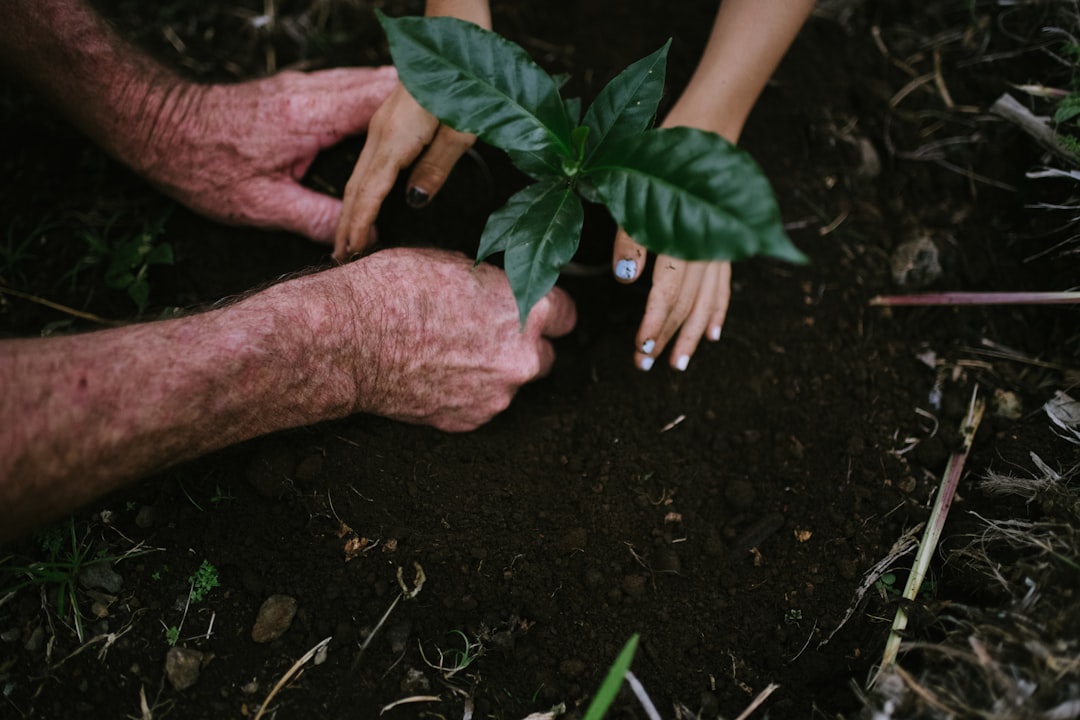
At last they planted a new tree together. The old man held the sapling while Auntie Qiaolan filled in the soil; halfway through, they switched—Auntie Qiaolan holding the sapling, the old man shoveling. The foreigner was no good at the work, got mud all over his shoes, and laughed like a child.
When the tree was in the ground, Auntie Qiaolan clapped the dirt from her hands: “Twenty-six years. Even one tree a year would only be twenty-six thousand. Your money was diligent—it grew more than fifty thousand.”
The old man asked me what she’d said. I told him: She says, thank you for your trees, keeping watch over this home in your place.
The old man went quiet for a moment, gazing out at the forest, and then spoke for a long time. Here’s roughly what I translated:
“When I went back that year, I told people about a woman I’d met in China who planted trees, and no one believed anything could live in the sand. Now I understand—what survived wasn’t just the trees. It was that bit of stubbornness in the human heart. It grows no leaves, but it’s everywhere.”
The wind rose again. For the first time, there was no sand in it—only the sound of leaves rustling across the whole slope, like a crowd of people applauding.
Tonight I leafed through this notebook, from 2000 to today, and suddenly understood: Auntie Qiaolan was never just planting trees. Stroke by stroke, with fifty thousand trees, she had been writing a letter to that old friend across the ocean.
The sea is so wide, and their words incomprehensible to each other—but the trees said everything that needed saying.
Tomorrow, I’m going to pick up my saplings.
(This story is adapted from true events; all names are pseudonyms.)
Based on a true story