The Cloth Is Alive
1
Nianhe smelled it before anything else.
On the thirtieth floor of an office tower, the central air conditioning never stopped. She opened the courier box and found an indigo scarf, folded square and neat. A cool, herbaceous scent rose from the weave—not perfume, but indigo. The smell of Wuling Village.
She pressed the scarf to her face, and through thirty floors of concrete and twelve hundred kilometers, she heard the loom.
Thwack, click. Thwack, click.
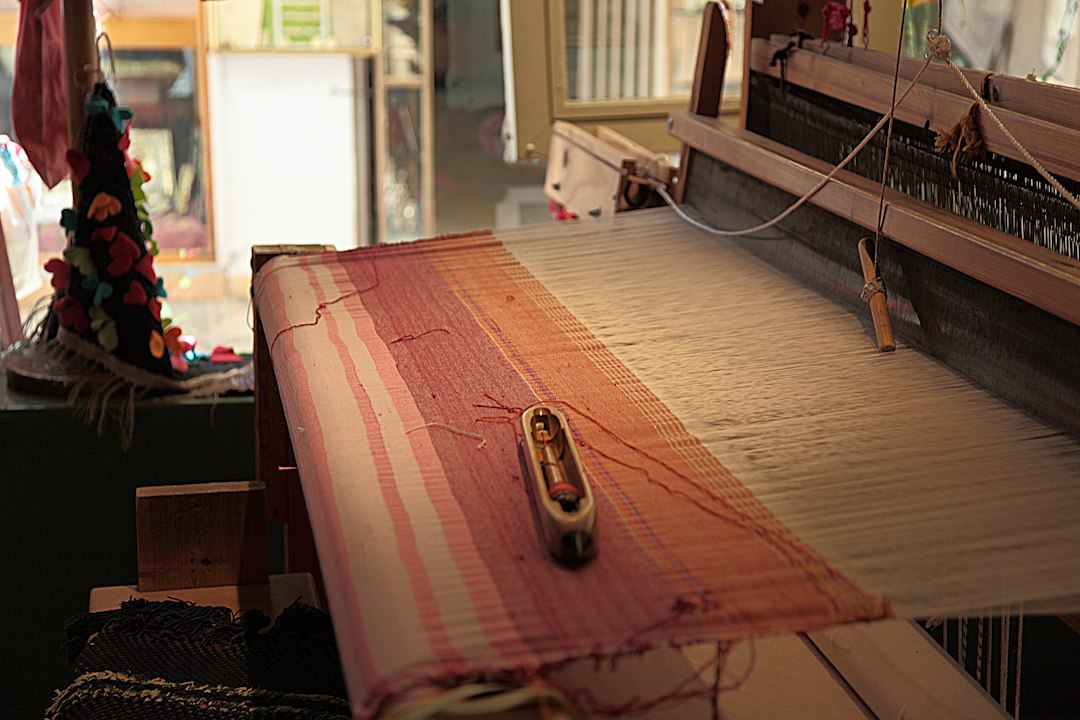
It was a sound that had grown into her bones since before she could remember. Before dawn, the wooden loom beside the fire pit woke first, more punctual than any rooster. Her mother, A’cai, sat before it with her back perfectly straight, the shuttle darting through the threads like a silver fish.
A few days after New Year’s, Nianhe told her mother on a video call that her company was developing a new color line called “Eastern Blue.” The meetings had gone on for a month; they’d worked through seven rounds of swatches, and the creative director still wasn’t satisfied.
“He says it’s too rigid,” Nianhe said. “He says this blue doesn’t breathe.”
Her mother didn’t understand what “breathe” meant. She thought for a while, then said: “That’s because they’ve never seen living cloth. Wait till my new weave comes out of the vat—I’ll send you a piece.”
Nianhe had laughed it off. Now, with the scarf against her face, she couldn’t laugh.
This one piece of cloth: her mother had sat at the loom for forty years to make it.
2
The first rooster in Wuling Village crowed at four-thirty.
A’cai was already sitting by the fire pit. Pine kindling for the fire, rice steaming in the wooden steamer, pig feed bubbling in the iron pot. She was fifty-four this year, and her hands were still the quickest in the village. She fed the pigs, steamed the rice, trampled the dew off the two vegetable plots—only then did the sky begin to pale.
When she came back, the first thing she did was not rest. It was weave.
The wooden loom stood against the wall, built for her by her father-in-law the year she married. The warp was stretched taut, indigo thread interlaced with the finest white, pattern by pattern, row by row. She picked up the shuttle and sent it with a flick of her wrist—thwack, click.
The village cloth held to “three colors”: white was cotton, blue was indigo, and the faint hidden patterns between them were picked out by counting threads. The wave pattern was the river the ancestors crossed; the mountain pattern, the ridges they climbed; the grain pattern, the seed rice they carried on their backs. Old Yin Gong used to say: our people never had a written language. Every road we walked, we wove into the cloth.
At the thirtieth shuttle, A’cai stopped.
She narrowed her eyes and leaned in. On that last pass, the white thread had slipped a notch—the grain pattern tilted by half a hair.
One thread off, and the whole pattern went crooked. She unraveled the row and began again. Her hands were steady, but something lurched inside her—she’d unraveled twice last month. This month, that made three.
Her eyes had started to blur since autumn came. To see the threads, she had to hold the cloth up to the window light, then bring it close to her nose, the way you’d smell a newborn baby.
By midday, she cut a length of fresh-woven cloth from the loom and carried it to the indigo vat in the corner of the courtyard. She lifted the wooden lid, and a rush of rice-wine and plant scent rose up.
New cloth into the vat, soaked through, pulled out—it was yellow-green.
A’cai shook the cloth open and held it above her head. As the mountain wind passed through, the cloth slowly changed color in her hands, green turning to blue, the way the sky darkens at dusk, sinking inch by inch.
The cloth comes out of the vat green; only in the wind does it turn blue. She’d known this since she was five. Her mother-in-law used to say: cloth is like people. You can’t rush it. When the time comes, it changes on its own.
She hung the cloth on the bamboo pole and went back inside. Under the window light, the loom sat quiet, waiting for her to return.
3
Zhou Xiaoman came into the mountains carrying two cameras, three batteries, and one phone.
On the phone was a thirty-second video: shaky footage, poor light, a woman in indigo clothing seated at a loom, never lifting her head, the shuttle too fast for the eye to follow. The caption was a single line: This is how people still weave in my grandmother’s village.
Three months earlier, Xiaoman had scrolled onto it late at night, and his thumb had stopped. He was a documentary filmmaker—he’d shot the sea, the snow line, a wholesale market at four in the morning. But that sound in the thirty seconds—thwack, click—quiets the heart even through a phone screen.
He followed the comments for half a month before he found Wuling Village.
The village sat in a gorge folded between two great mountains, wooden houses stacked story upon story, drying racks standing on the slope like rows of upright zithers. He asked several people before someone said: the weaver? A’cai. The house at the top of the slope.
A’cai was hanging cloth in the courtyard. When she saw him, her first question was: “Have you eaten?”
Before he could answer, she’d already gone into the kitchen.
Xiaoman explained why he’d come—he wanted to film her, the weaving, the indigo vats. A’cai fed the fire, the flames lighting half her face.
“You can film,” she said. “One condition: don’t slow down my work.”
“And if I need you to weave something just for the camera?”
A’cai pressed the firewood down into the flames and looked up. “Cloth can’t be hurried. The thread has to wake. The indigo has to ripen. A person has to be able to sit still. If you want to film the real thing, you wait with me. If you want something fake, go home.”
Slowly, Xiaoman lowered the phone he was still holding. “Auntie,” he said, “I’ll wait with you.”
That evening he stayed in the village, slept on a plank bed that smelled of fresh wood, and listened to some unseen household’s loom clattering late into the night upstairs.
Thwack, click. Thwack, click.
Like the mountain, breathing.
4
The winter Nianhe was eight, her father went into the mountains and never came back.
Most of what followed is lost to her now, except this: her mother moved the loom beside the fire pit and did not rest a single night all winter. Nianhe would wake from sleep and hear the loom; wake at midnight—still going; at dawn with the roosters—still going.
On the twenty-sixth of the twelfth month, her mother shouldered six bolts of cloth and walked down the mountain to the market town, trading them for Nianhe’s school fees and two jin of pork. At New Year’s Eve dinner, the meat was sliced paper-thin. Her mother didn’t eat a single slice; she pushed them all into Nianhe’s bowl.
“I don’t care for fatty meat,” her mother said. Only years later did Nianhe understand: in those days, even the lean was saved for growing children.
Nianhe was the first girl in the village to get into university. The night before she left, her mother called her to the loom and handed her a new quilt. Indigo ground, patterns picked at the four corners, and across the cover dense rows of tiny stitches—grain motifs embroidered by counted thread.
“Wherever you carry the seed rice, that’s where you can live,” her mother said. “That’s the old saying of our village.”
At university, what Nianhe dreaded most was being asked where she was from. Deep in the mountains—those four words, she couldn’t bring herself to say. Once, in a dormitory night talk, a roommate turned her pillowcase over in her hands: “This embroidery is exquisite. Bought it online? How much?”
“Mm,” Nianhe heard herself say. “Bought it online.”
The quilt her mother had woven she folded neatly and pressed into the bottom of her suitcase. Four years, and she never had the heart to use it—nor dared to. Afraid people would ask. More afraid of her own guilt.
After graduation she joined a clothing company as a designer—sketching, color-matching, chasing every season’s trend. She understood “fashion” better than anyone, until the company set out to find a blue that “breathed.” The whole team went through thousands of swatches and found nothing.
Working late one night, she dialed her mother as if in a trance. She said nothing about the project—only asked: “Ma, are your eyes all right?”
“Perfectly fine,” came her mother’s voice, tangled up with the sound of the loom. “As long as the machine’s going, these eyes can tell every single thread.”
Nianhe held the phone and, for a long time, said nothing.
5
It wasn’t until his tenth day in Wuling Village that Xiaoman understood what “waiting” meant.
A’cai’s days had their fixed hours: to the fields before dawn, weaving at midday, feeding pigs and dyeing cloth in the afternoon, back at the loom after dark. Xiaoman trailed her with his camera—filming her with a baby strapped to her back, soothing the neighbor’s child; filming her crouched at the vat, testing the water with her forearm; filming her draping a length of cloth over the bamboo pole as the mountain wind passed through and, in the space of a few breaths, the green turned blue.
“Auntie,” Xiaoman said, eyes on the viewfinder, his voice unsteady, “could you dye one more length so I can film it? Just ten seconds.”
“What’s the rush?” A’cai sat on the doorstep. “The vat isn’t going anywhere. There’s tomorrow, too.”
Later, Xiaoman named that footage “The Ten Seconds the Cloth Wakes.”
The more he filmed, the more the villagers accepted him. Old Yin Gong, leaning on his cane, took him to the ancestral hall to see the old ceremonial costumes—a single garment carrying a hundred years of patterns, layer upon layer.
“As the old saying goes, our ancestors had no writing,” Yin Gong said, tapping the designs with his cane. “The roads are in here. The rivers are in here. The seed rice is in here. To wear it is to carry your ancestors with you.”
Xiaoman asked A’cai: your children have all gone out into the world—what do you get from keeping this loom? Nianhe’s tuition was long since repaid, wasn’t it?
A’cai was sizing thread, rice water steaming in the pot. She didn’t look up.
“The tuition’s repaid, yes,” she said. “But these patterns have been handed down in this village, generation to generation. They’ve come into my hands, so they’re mine to keep. As long as I keep them one year, I owe them one year. If they grow old and die along with me—when I go down below and face the ancestors, what will I have to say for myself?”
She shook out the sized thread, a billowing white sheet, like holding a small snowfall.
“Besides,” she said, and for once smiled, “my eyes can still see. While they see, I weave another inch.”
Xiaoman looked down and adjusted his camera. He didn’t want her to see his eyes go red.
He named that day’s footage and filed it on his hard drive: While I See, I Weave Another Inch.
6
On the first Monday of November, Nianhe laid the cloth swatch on the conference table.
The creative director had been looking down at something else. He glanced up, and stopped. He picked up the cloth, held it against the window light, pressed it to his cheek, rubbed it, listened to the sound of the weave against itself.
The room stayed quiet for a long time.
“Where did this blue come from?” he asked.
“My mother wove it,” Nianhe said. In the instant those five words left her mouth, she heard some door inside her swing open. “Handwoven. Dyed with indigo. The way they do it in our village.”
“Can you get more? What about volume?”
“Not much volume. Handwork can’t be rushed.” Nianhe paused, then said the words she’d prepared through the whole night before: “But every inch is different. Every inch is alive.”
The director looked at her for a few seconds, then suddenly smiled. “Next week, we go to the source. This blue—we want the real thing.”
That night, scrolling her feed, Nianhe came across a documentary that had just gone online.
The cover image: a pair of hands and a vat of blue. The title: The Cloth Is Alive.
She clicked in. Three minutes in, she saw her own mother. In the frame, A’cai sat at the loom, unraveling a miswoven row, holding the cloth up to the window light, then bringing it to her nose, squinting, counting the threads one square at a time.
A comment drifted past: “This auntie’s eyesight doesn’t seem too good.”
Nianhe’s finger froze on the screen.
She watched the scene again, frame by frame: when her mother counted threads, she had to stretch the cloth a full arm’s length away. When she unraveled, she leaned in so close her nose nearly touched the cloth. When she stood, her hand reached out to the loom—to a spot she’d never needed to feel for before.
When did it start? Why had she never said a word on the phone?
She called. It rang a long time before her mother answered, mountain wind in the background.
“Ma, your eyes.”
“Fine as ever,” her mother said. “The machine’s getting old, and the person gets old with it. Perfectly normal.”
“The county hospital can fix it. Cataracts. A small operation, just—”
“Cut into my eyes in the middle of winter-weaving season?” Her mother’s voice dropped. “Three hundred sixty-five days, and this is the one quiet season. Can’t be wasted.”
On the other end, dogs barked twice in the village. Her mother gentled. “You mind your own work. Your mother knows what she’s doing.”
Nianhe sat at her desk with the phone in her hand. The whole floor’s lights had gone out; only her screen glowed, still holding her mother’s face.
Your mother knows what she’s doing. She’d heard it all her life. But this time, she was afraid her mother would count wrong.
7
Before the twelfth month, two big things happened in Wuling Village.
The first was that the documentary went viral.
Xiaoman’s film ran forty minutes, with no narration, no score—only the loom, the dye water, the roosters and dogs of the village. Nine days after release, it passed ten million views. The most-shared clip was exactly “The Ten Seconds the Cloth Wakes”—green cloth out of the vat, one pass of mountain wind, and deep blue. The comments filled with questions: Where is this place? Can we buy the cloth?
They could. In forty years of weaving, A’cai had never once been chased down by buyers.
People from the county intangible-heritage station came up the mountain, saying they wanted to register “Auntie Cai” as a heritage bearer, saying they’d fund a cooperative. Two young wives of the village who’d left for work in the cities, Chunzhi and Ermei, watched the film and came back one after the other, sitting in A’cai’s courtyard learning to arrange the warp. Yin Gong carried the century-old ceremonial costume out of the ancestral hall to sun it, laughing the whole way.
But when the orders came, so did trouble. A city company sent a letter: could production move to machines? Three thousand bolts a month?
A’cai had Nianhe send back the answer: “What the machine weaves is me, and it isn’t me. They want the living thing, and machines can’t give them that. If they’ll wait, come. If they want it fast, forget it.”
Nianhe passed the words along word for word. The director was silent a long time, then said: “Then we do it her way. A handwoven line. Two batches a year. We’ll wait.”
The second thing was not so dignified.
A’cai was lighting the fire in the kitchen when Chunzhi called her over to check the pattern placement on a bolt of cloth. She rose too fast; the fire tongs knocked over the kettle of hot water beside the stove, and scalding water splashed her forearm, raising a red welt. It wasn’t serious—but the whole village was shaken. Auntie Cai had never made a mistake like that.
That night, Xiaoman’s camera caught this: A’cai alone at the loom, not weaving, just sitting. After a long while, she reached out and touched the loom’s crossbeam, the way you’d stroke an old companion’s back, and said something softly.
Xiaoman watched the footage three times, and in the end cut it from the film. Some words are not for outsiders.
He himself heard it clearly. She said: “Old friend, you’ve kept me company thirty years. If my eyes give out, what will become of you?”
The next day, Nianhe took her annual leave—one day on the high-speed rail, four hours of mountain roads—and reached the village at dusk.
She pushed open the courtyard gate. Her mother sat at the loom, silhouetted against the light, holding a length of thread at arm’s reach, squinting as she counted.
Nianhe stood in the courtyard, looking at that figure—the back still straight, only the hand holding the thread trembling a little more than in her memory.
“Ma,” she said. “Tomorrow I’m taking you down the mountain.”
A’cai turned, startled. Her first words: “What are you doing back here? Does leave come out of your pay?”
“Ma.” Nianhe crossed over, crouched down, and took her mother’s hand. It was covered in calluses; the crook of her thumb still carried a fresh red burn. “I watched the video. I saw the cloth. The whole world has seen you—everyone but me, because you hid it.”
A’cai looked at her daughter, and looked, and looked. Smoke from the cooking fires rose and dissolved into the mountain mist.
She sighed, and at last nodded. “Fine. Go quick, come back quick—you’ll only miss a few shuttles.”
8
At the county hospital’s eye clinic, the doctor examined her and said: “Cataracts. Half-ripe—right on time. A small operation. Don’t be afraid.”
The morning of the surgery, Nianhe held her mother’s hand and walked her to the operating room. Lying on the gurney, A’cai was still giving instructions: “Don’t burn all your leave on me. Go back to work. I’ll be out tomorrow.”
“Ma,” Nianhe said, “I’m not going anywhere today.”
The surgery took twenty minutes. The nurse said it went very smoothly.
The next day, the bandages came off. The doctor peeled back the gauze layer by layer. “Open your eyes. Slowly.”
A’cai opened her eyes.
The white walls of the ward came flooding in first, then the window, the mountains beyond it, fold upon fold of green. She froze a moment, then slowly turned her head and saw Nianhe beside the bed.
She stared at her daughter’s face a full five seconds, and then said: “When did you get freckles at the corner of your eye? Just like your grandmother.”
Nianhe’s tears came all at once.
“What are you crying for?” A’cai reached up and wiped the corner of her daughter’s eye. The hand was steady—not a tremble in it. “The eyes are fixed. Tomorrow I can start arranging warp.”
The day she was discharged, the sky was glorious. A’cai refused all support and walked so fast that at the hospital gate she stopped, squinted, and read the shop signs across the street, character by character—then laughed first of all at herself: “That character—it’s still written the way it used to be.”
On the mountain road home, she rode looking out the window the whole way. The terraced fields, the river, the last rows of unhusked glutinous rice on the drying racks.
“Nianhe,” she said suddenly, “isn’t it strange? When my eyes were going, I thought what I couldn’t bear to lose was these two eyes. The moment the gauze came off, I learned it wasn’t that. It’s all this.”
“All what?”
“The green fields. The white road.” She said it, then glanced at her daughter and stopped, the corners of her mouth smiling.
Nianhe understood. She turned to the window and forced the tears back.
Home again, her mother walked straight to the loom and slapped the crossbeam twice, like greeting an old friend:
“What’s the hurry? I’m back.”
9
In the twelfth month, the year’s first frost settled on Wuling Village.
In the courtyard of the house at the top of the slope, a new wooden plaque hung: Wuling Weaving and Dyeing Workshop. The characters were written by Yin Gong, who said this word for “workshop” was one the ancestors used; it should be brought back.
Five looms stood inside. One for A’cai, one each for Chunzhi and Ermei, and two new ones from the heritage station, waiting for more of the village’s women to come home. The county’s blueprints and Nianhe’s company’s orders were pinned to the wall, marked: “Handwoven line. No rush on deadlines.” The day the first samples of the “Searching for Blue” collection reached the company, the director replied with one line: “This blue is worth the wait.”
Nianhe used up her annual leave, then banked every weekend’s compensatory time and went up the mountain once a month. Eventually she simply negotiated it with the company: she’d do “origin-tracing design,” and spend half her time in the village. Saying it, she remembered the girl of four years earlier who couldn’t admit where her pillowcase came from, and her heart ached and warmed at once.
This morning, before the frost had melted, the loom woke first.
Thwack, click.
Nianhe sat at another loom, learning to arrange the warp. The warp threads had to be sorted one by one from thousands, laid out in their pattern order—rush one thread, tangle a whole field. After an hour of work, the pads of her fingers carried their first red marks.
“Sit up straight,” her mother said behind her, her own hands setting Nianhe’s back upright. “Straighten the thread, straighten the spine. Your great-grandmother-by-marriage passed it to me. Today I pass it to you.”
Nianhe straightened her back. The shuttle came into her hand. Mimicking her mother, she sent it off with a flick of her wrist—
And in the instant the threads closed together, she understood at last why that sound quiets the heart. It isn’t the noise of a machine. It is work you can see, inch by inch.
At midday, the vat’s lid came off. A new batch of cloth went in. A’cai lifted out one length, shook it open, and held it above her head for Nianhe to see—
Yellow-green cloth, one pass of the mountain wind, and in the space of a few breaths it sank slowly into deep blue.
“Remember this,” her mother said. “The cloth comes out of the vat green; only in the wind does it turn blue. People are the same. You can’t rush it. When the time comes, it changes on its own.”
That afternoon, at the loom, Nianhe made a request. There was an old rule in the village: the hem of every ceremonial costume kept one last square called the “added pattern,” woven with that family’s year—the ripeness of the grain, whether a child had been born, how much joy there was. She wanted to weave this year into the added-pattern square of her own garment.
“What will you weave?” A’cai asked.
“A white road,” Nianhe said. “A road that comes back from beyond the mountains. And on the road, three grains of rice.”
A’cai looked at her a long time, and her eyes curved into crescents. “Good. This square, you count the threads yourself. If you miscount, your mother will unravel it for you and you’ll weave it again—your mother’s eyes are in fine shape now.”
Night fell, and the looms went on sounding. Two looms, one before the other, one quick, one slow, like the mountain answering itself.
Nianhe bent over her threads. The plant-scent of indigo settled into the creases of her fingers, the kind that won’t wash out. She remembered suddenly: half a year ago, on the thirtieth floor of an office tower, she had needed a scarf to bring Wuling Village back to her.
Not anymore.
Now the loom was sounding in her ears, the indigo was on her hands, and her mother sat three steps away, back straight as a warp thread.
Thwack, click. Thwack, click.
The cloth is alive. It is still growing.
—This story is adapted from real events. All names are pseudonyms.
Based on a true story