Nine Clay Pots
“Mama, who is that woman?”
I was twelve that year. Beneath the great banyan at the village gate, a woman crouched before a bamboo sieve, picking through seeds. One by one, she picked slowly, as if counting a string of beads.
Grandmother squinted over and said, “She saves seeds.”
Those were hard years. A few years earlier, a man in a white shirt had come to the village with glossy little booklets, saying the new seeds were better than the old ones—higher yields. Plant his seeds, spray his chemicals, and every family would raise brick houses. Father believed him and borrowed money for a sack of the new seed.
The first year, the harvest was good. The second year, it failed. The booklet said the new seeds lived only one season—the next year you had to buy again, and buy the chemicals again. The debt compounded like the banyan’s aerial roots, hanging lower and lower, wrapping around a man until he couldn’t breathe.
In those days, a few households in the village kept their doors shut tight. People passing by walked softly.
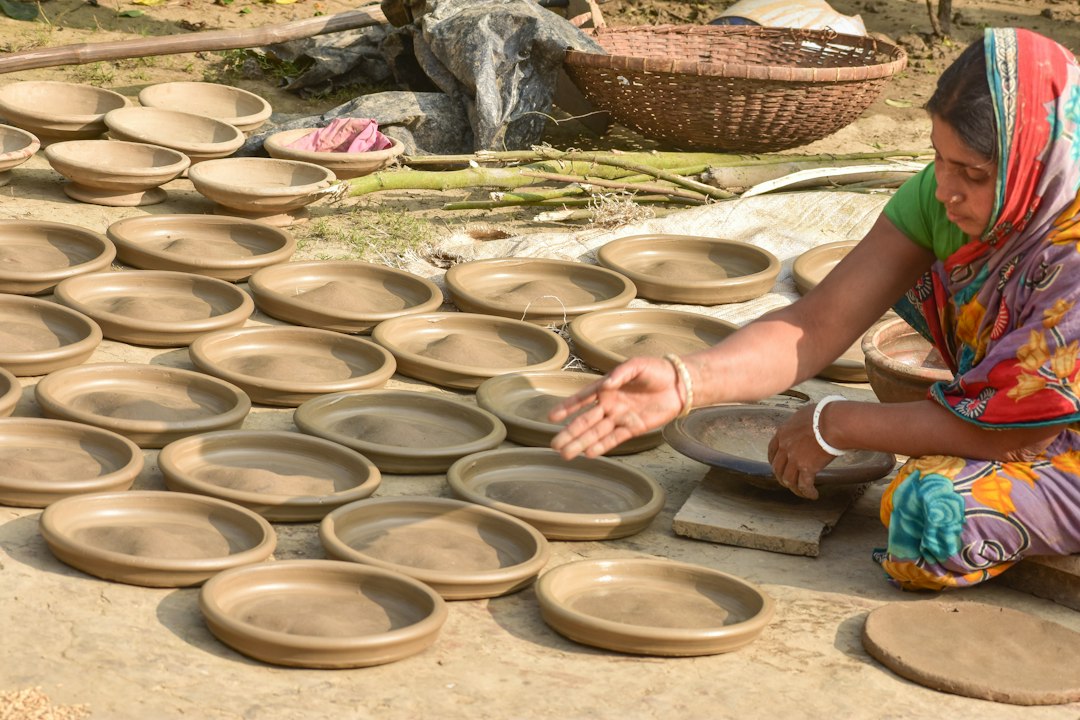
It was then that the seed-saving woman arrived. Her name was Shanti; the elders called her Sister Shanti. The first time she came, she brought nine clay pots—her dowry, she said, given by her mother when she married. One kind of seed to a pot: rice, millet, lentils, okra, bitter gourd… The pots were unglazed, their mouths no wider than a palm, plain and unremarkable.
She lined up the nine pots and told everyone: “Whatever your household lacks, come borrow. Return twice as much after harvest. If the harvest is bad, don’t return it at all.”
Someone asked, “And if the seeds die?”
“Then I’ll bring more,” she said. “The seeds must not run out. Lose one kind, and a kind is gone forever.”
Father didn’t go to listen. He said the old seeds yielded too little to make money. He said the woman was crazy—nine pots of seed weren’t worth a sack of fertilizer.
And yet at night he said little. The account book stayed locked at the bottom of a chest, its key hung against his skin.
Midway through that year, the white shirt returned, booklets in hand. Seeing the crowd under the tree, he laughed aloud: “Madam, what century is this, still saving seeds? Seed is business—leave it to the companies. You just plant. Plant it well.”
Shanti didn’t take offense. She scooped up a handful of lentils and spread them across her palm: “Once, when a daughter married, her dowry was seed. Seed passed from grandmother’s hands to granddaughter’s. You say seed is your business—go ask the grandmothers if they agree.”
Laughter rose from the crowd. The white shirt said nothing more, tucked away his booklet, and left.
After school I did my homework under the banyan. Sister Shanti taught me to write labels: which pot held what, which village the seed came from, which year it was saved—line by line, hung from the pots’ necks. For the first time I learned that seeds had so many names. Every name was alive, she said; if no one spoke it for three years, the name died.
Nine clay pots slowly became a houseful of clay pots. The room grew small, so families pooled timber and raised another. People from neighboring villages walked five or six li to borrow seed; some came carrying their own grain to trade.
Sometimes Sister Shanti would vanish for a while. Word was she’d gone to the far-off big city for a lawsuit—someone had wrapped seeds in a shell, locked them up as their own property, charging a fee each time the lock was opened. Sometimes news came that she’d lost. She never spoke of it when she returned. She just crouched down and went on picking seeds, one by one.
I asked her, “Auntie, if you lose the lawsuit, is it all over?”
She blew the shriveled grains from her palm: “The lawsuit can be lost. The seeds must not stop. Seeds don’t wait for lawsuits.”
The third year came the drought. Four months without rain. The new seeds in the fields wilted first—shallow roots, tender hearts. The old millet held on, leaves curled tight, and endured until the first rain.
That autumn, Father crouched on the field ridge for half a day. On the way home he walked ahead of Grandmother and me, and quietly set down his sickle.
Early the next morning, he stood beneath the banyan with an empty cloth sack on his back, his waist bowed low.
Shanti filled it with a full two liters of seed. He said, “If… if I can’t pay it back…”
She said, “Farming is a negotiation with the sky—no one wins every round. Get the seed into the ground first.”
Father shouldered the sack and walked fast, never once looking back, as if afraid someone might see his eyes.
The next year he returned two liters of seed, plus a sack of fresh millet on his back. He set it down, didn’t leave—sat in the crowd until dark. In later years, whenever a young villager got the idea of buying new seed, Father would take the account book and sit a while on his doorstep. He’d say nothing. Just leave the account book open on the table.
The seed station moved into a bigger house. Those first nine clay pots sat on the highest shelf; Shanti let no one touch them.
This year, I too learned to save seeds. Shanti is old now, her braid half white, but she still walks from village to village. Yesterday I brought the children to see the seeds. A little girl with pigtails pointed at the shelves: “Sister, who saved all these pots?”
“A woman,” I said. “When she married, her mother gave her nine pots of seed as a dowry. And she shared the seed with everyone.”
The girl asked, “Then whose seed is it?”
Before I could answer, thunder rolled across the sky. The monsoon had come—the first rain of the year. The children shrieked and ran out the door. I picked up a pot of millet seed, ready for the fields.
Rain fell on the roof, on the threshold, on the fields parched all season. Shanti stood by the door and said, “Time to sow.”
On the highest shelf, nine clay pots rang softly in the sound of rain, as if something were quietly beginning to sprout.
(This story is adapted from true events; all names are pseudonyms.)
Based on a true story