The Rain Comes from the Sea
I. Rain
Past fifty, I often can’t tell which things I actually saw, and which were told to me by others and then completed, stroke by stroke, in my midnight hours. Memory is like that old sponge on the counter of my shop—everyone’s words have pressed down on it at some point, and pressed often enough, the depths all blur together.
But one thing needs no completing. The rain of that April—every drop I saw was real.
I have repaired shoes by the canal in Milan for twenty-six years. The shop is one and a half rooms: the front half holds the machines, the back half is piled with shoe lasts. I wrote the sign myself: in Chinese it says “Wei’s,” and in Italian, “Sorriso.” The landlady looked it up in the dictionary for me back then. Sorriso, she said, means a smile. A customer won’t remember a shoemaker’s face, she said, but he’ll remember a sign that smiles.
For twenty years, from behind that pane of glass, I have watched the life of the whole street: the bread van at dawn, the old man walking his dog at dusk, the drunk young men singing while hugging lampposts, and every spring, the children splashing through puddles on their way to school. The street is like a documentary without subtitles, and I am its only silent viewer.
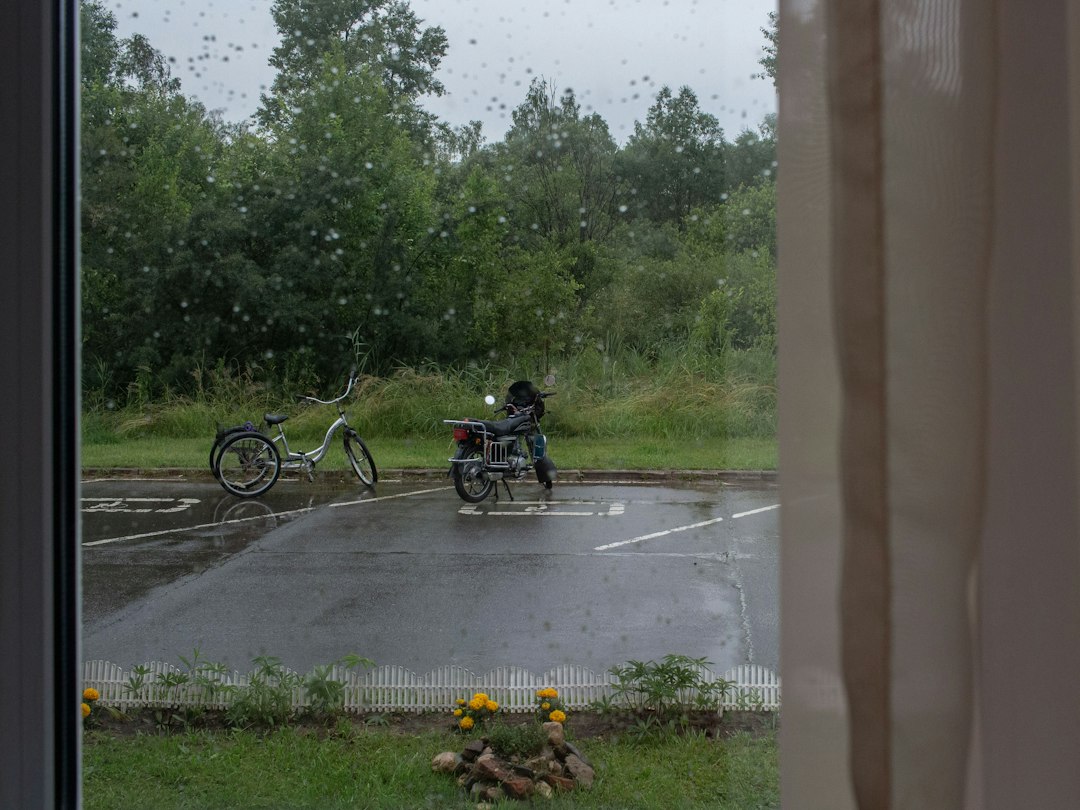
April in Milan has no manners; its rain arrives without warning. That afternoon it came down especially hard, as if the sky had been stabbed through, and the people on the street scattered in an instant while white steam rose from the rooftops.
I was closing up when, through the glass, I saw that bicycle.
II. The Door
It was a touring bike, covered in faded stickers layered one over another, like the rings of a tree. Panniers hung on both sides of the rear rack, bulging—two camels grown thin from the road. A small solar panel was strapped to the tail, held in place by rubber bands and faith.
The bell was broken. The man pushing the bike pressed it now and then anyway; no sound came, and he would smile to himself, as if exchanging a word with an old companion.
He stopped across the street under Rosa’s awning to shelter from the rain. Rosa lived on the ground floor of the yellow house, geraniums blooming on her windowsill all year round. Every morning she stood at her door with a tiny espresso, staring blankly at the canal water. I’d known her more than twenty years. She called me “Lao Wei”—she couldn’t pronounce it properly, and it came out sounding like “Weh.” Every time she shouted “Weh!” across the street, half the block turned around.
Rosa was the most cautious old woman I have ever known. Two locks on her door; after dark she answered no knock. Even taking out the trash, she clutched the keys in her palm so hard they left a mark.
But that afternoon, I saw her open her door all the way.
The man pushing the bike was Chinese. In his fifties, beard gone gray, skin burned a dark red—but his eyes were bright, like two nails fresh from the forge. He waved his hands in refusal again and again, and Rosa’s Italian rose in octaves, as though foreigners failed to understand simply because the voice wasn’t loud enough. The two of them swayed at each other across the rain, like two trees in the wind.
Then Rosa stopped waving. She came down the steps and reached out to steady the bike. It was too heavy for her; she stumbled. The cyclist rushed forward, one hand catching her, the other catching the bike. And so—one person holding up another, a bicycle linking itself to a man—they went in through that door opened all the way.
The rain went on falling. I watched from behind the glass for a long time and thought: has Rosa lost her mind?
Later I learned that the one who had lost his mind that day was me.
III. Names
Some of what follows Rosa told me herself; some of it Giovanni let slip, sentence by sentence, in my shop while he waited for a heel to be fixed.
Before retiring, Rosa had been a seamstress—thirty years in a small workshop, steady hands, steady eyes. Her husband Giovanni repaired clocks and watches, and spoke less than a pendulum. The two of them never had children of their own. Twenty-five years ago they took a very long flight and came back from China with a baby girl, only a few months old.
The orphanage caretakers called her “Xiaoman”—she had been brought in just as the solar term of Xiaoman, Grain Full, had passed. Rosa didn’t let the name vanish; she made it her daughter’s middle name. And Giovanni, dictionary in hand, gave the child an Italian name: Mia.
Mia, Giovanni said, means “mine” in Italian.
“From today on, she is ours.”
I watched Mia grow up. Every year she came to my shop to replace a schoolbag strap, and later, to replace her heels. A girl who talked fast, walked fast—her heart faster than her feet. Rosa sewed her a spring coat by hand each year, larger and larger; when coats were no longer the measure of her, she sewed scarves. Giovanni taught her to tell time using the broken watches on his workbench—he said that in a watchmaker’s hands, even the most broken watch is still running, only more slowly.
The year she graduated from art school, Mia did something that kept the whole street awake: she packed her bags and went back to China. To the region where she was born—a rehabilitation school in a small city in the southwest, to teach painting to children whose bodies didn’t work the way most bodies do.
Giovanni didn’t live to see that day. He died six years ago, one watch half-repaired on his bench. Rosa wound it and set it on the windowsill. It keeps perfect time, as if someone were still bent over the bench, working.
IV. Sundays
Every Sunday afternoon, a small square of light would appear over Rosa’s windowsill. That was her video call with Mia.
These Sundays are like beads strung on a thread; I’ve picked up a few here and there—some Rosa told me about, some from when I happened to be there and argued a bit in Chinese with the far side of the screen.
Mia’s landlady was surnamed Chen; Mia called her Auntie Chen. Every few days Auntie Chen would hang something on Mia’s door handle: a bunch of scallions, a few oranges, a length of home-cured sausage. Nothing worth any money, and never the same twice.
The mechanic downstairs changed the chain on her bicycle and absolutely refused payment. Mia pressed the money under his toolbox; he chased her two blocks down the street and pressed it back into her basket, saying: “A young girl on her own out here—it’s not easy.”
The year she had acute appendicitis, the parents of her students lined up to bring her soup; she was discharged before the soup ran out.
The old woman selling vegetables at the market remembered, from the second visit, that she couldn’t stand cilantro. The school janitor brought in her laundry from the rooftop whenever it rained. Once she sprained her ankle on the stairs, and three total strangers carried her to the infirmary—debating the entire way about which of three routes was shortest. At Spring Festival, a colleague dragged her home for New Year’s Eve dinner and taught her to make tangyuan; hers all split open in the pot. Her colleague said: that’s called “opening smiles”—it’s a good omen.
One of her students drew a picture of her with wings and stuck it on the back wall of the classroom, with a few wobbly characters beside it: Our teacher’s wings are invisible.
Rosa once stuck a note on my counter and had me write in pinyin: Mia, have you eaten? She practiced from it. The first Chinese phrase she learned was “Eat a little more.” Mia had been a picky eater as a child, Rosa said; from half a world away, the phrase would always come in handy.
On weekends, Mia went to one more place. The orphanage. She taught painting to the children there. The children didn’t know that their teacher had also been carried out through that very door, twenty-five years ago. Only Rosa knew. Every time she came to this part of the story, she would pause—like a needle catching for a moment on thick cloth.
Rosa once said something to me, very softly, as if to herself:
“They took my daughter as their daughter.”
V. The Leg
That evening, the rain thinned. Rosa led the cyclist into my shop.
Her reason was practical: the stitching on his left shoe had split, and a pannier strap had broken.
Up close I could see that below his left knee was a prosthetic leg, carbon fiber, the calf wrapped in an old layer of felt. Twenty-six years of repairing shoes, and I knew at a glance: that shoe would never need a shoemaker.
His surname was Cen, from Hunan, a welder by trade, fifty-four years old. His wife had died early; his daughter had married and settled in Hangzhou and couldn’t talk him out of anything. Four years ago, a workplace accident—the machine ran over his left leg. He told it calmly, as if describing something that happened to someone else. Only at the word “machine” did something catch in his throat, like a spark lodged there.
“In the recovery ward, the bed next to mine had a little girl, seven years old, amputated too, below the knee,” he said. “One day she asked me: Uncle, with a fake leg, can you still ride a bicycle?
“I said: Yes, you can.
“She ran and told the whole nurses’ station. Told everyone—the uncle said, yes, you can.” He smiled, and the wrinkles at the corners of his eyes seemed to hold dust, or else light. “I owed that child one word: yes. I want to pay it back.”
Last autumn he set out from Shanghai, heading west. In Kazakhstan, herders took him into their yurt and slaughtered a sheep. In Turkey, a teahouse owner saved him the first, hottest pot of the day, every day. In Bulgaria, a shepherd walked beside him pushing the bike all afternoon without saying a word, then pressed a package of sheep’s cheese into his hands at parting. When he spoke of these places, he counted them out like banknotes. I said: you’re counting your fortune. He shook his head.
“I’m counting lamps.”
He showed me his phone. The photo album had hardly any scenery—only people, screen after screen of people: those who’d helped him, and those he’d helped. “On the road there are no strangers,” he said. “Only debts of kindness that haven’t been repaid yet.”
I bent over his shoe. A prosthetic foot can’t be handled carelessly. I double-threaded the split, back-stitched it, and padded the lining with a ring of soft leather—the prosthetic and the shoe fight each other, and it’s the flesh that pays. He crouched beside me and watched me sew, for a long time.
“I welded iron for half my life,” he said. “A weld rusts. A stitch doesn’t.”
When the shoe was done, I replaced his pannier strap with new webbing too. He took out his money; I waved it away and pointed at the sign: Sorriso. He understood. He laughed, loud enough to make the shoe lasts rattle softly on their shelf.
That night I was summoned to Rosa’s. Rosa wanted me to interpret for her and Master Cen—her hands had been doing the talking all afternoon, and they were tired. She took the broken strap with her too, she said, so that tonight the sewing machine could have a word with it.
VI. Dinner
Rosa made saffron risotto. The rice was golden—the color of Milan. She hardly ate herself; she just watched us eat, the way you’d watch two trees after a long drought.
The walls were covered with photographs. Young Rosa standing at her sewing machine. Giovanni squinting one eye, winding a watch. Mia, from the swaddle of her first month to the day she wore her graduation cap, year by year climbing the wall, like a staircase that smiles. In the corner stood an old sewing machine, its foot pedal worn to a shine, like a heart still beating.
At the table, a translation app, his gestures, and my half-baked Italian all stirred together—and somehow it was enough. Master Cen asked Rosa why she had dared to bring a stranger through her door.
Rosa thought for a moment. She looked first at Mia on the wall, and then she said it.
My hand trembled as I translated.
“My daughter is in China. It is the people of that land who are being good to her.”
The steam rose from the risotto. Master Cen said nothing. He put down his spoon, sat up straight, and nodded to Rosa, slowly, with great ceremony. This man who had lost half a leg under a machine, who hadn’t turned red even when a ram knocked him flat on the road—his eyes went red.
He dug a small paper packet out of his pannier and passed it over with both hands. Some tea leaves, from his hometown, carried on the road for seven months, never once allowed himself to drink them.
“Thank Teacher Mia for me,” he said. “And thank that small city for me too. My whole journey, I’ve been eating from a hundred households’ pots.”
Rosa took the tea and held it to her chest, like holding something she had finally waited long enough for. Suddenly she remembered something, pulled me over, and asked me to write a few Chinese characters on a slip of paper. I asked what.
“Kindness knows the way,” she said.
I wrote it out, stroke by stroke. Rosa folded the paper into a tiny square and tucked it into her apron pocket, the way you’d tuck away a seed.
VII. Stitches
The next day, at first light, the rain had stopped; the eaves still dripped.
I looked out from the shop: Master Cen’s pannier strap had had its conversation with the old sewing machine overnight—double thread, back-stitched, the seams as dense as a farewell written in another language, wishing a safe journey.
Rosa pressed things into his arms: a bag of cookies she’d baked, two oranges, a small bottle of olive oil. Then she took out the slip of paper with the Chinese characters and taped it to his handlebars—tape wound around three times.
Master Cen asked Rosa to stand beside the geraniums, stepped back two paces, and raised his phone for a photograph.
“Everywhere I go, I photograph the people who helped me,” he said. “When the album is full, I’ll probably be home.”
Rosa listened to my translation, waved her hand, and said something. I translated it for him:
“Don’t fill it up. Save room for next year’s flowers.”
As he wheeled the bike away, the broken bell rang—no, it still didn’t ring. And yet all of us, somehow, heard something. Rosa stood on her step waving, waving until the bike turned the corner, waving past the moment the rain had stopped.
VIII. The End of the Land
Master Cen went on west, out of Italy, past the sunflowers of southern France, past the olive hills of Spain. Now and then he sent me a message—a place name, and a photo of someone who had helped him: a Portuguese fisherman, half his teeth gone, smiling like the whole Atlantic. I would pick a few and translate them for Rosa.
In early June, a postcard arrived for Rosa. She carried it into my shop in both hands, like carrying a piece of porcelain she was afraid to break.
The stamp was Portuguese. On the photo, a sheer cliff, the sea beneath it, blue gone almost dark. Cabo da Roca, the westernmost point of the European continent. Master Cen had arrived.
On the back, in his writing, the strokes pressed so hard they embossed the address I had written for him:
“Mama Rosa: I made it. There’s a verse carved on the stone here—Where the land ends and the sea begins. I stood before the stone and watched the sea for you for a long time. On the other side of that sea is China.
“P.S. Duoduo has learned to ride a bicycle. Her mother sent a video—the little girl wobbling all over the place, falling once, getting up and riding on, laughing the whole time. I’ve paid back that word ‘yes.’
“You were right, Mama Rosa. Kindness knows the way. — Cen, at the end of the continent.”
I translated it line by line. Rosa turned the postcard over, and over again, like inspecting a piece of sewing gone wrong. Really, she was only pressing the tears back in.
“I have to call Mia,” she said. “Today isn’t Sunday.”
I heard about that night’s call from Rosa afterward. On the line, Mia laughed at first, then went quiet, and after a long while said:
“Ma, I helped someone yesterday too. A foreign old lady, going around and around at the school gate, unable to understand a word anyone said. I walked her to the bus stop and bought her a box of warm milk. She kept saying thank you to me.”
“I don’t speak a word of her language. But the melody, Ma—the melody of her thank-you was the same as yours.”
Rosa listened on her end of the line. On the windowsill, Giovanni’s watch ticked loudly.
The next day she came to my shop and told me the story, then summed it up herself: “You see? It really is a circle. I hadn’t finished drawing my side of it, and hers was already connected.”
IX. The Rain Comes from the Sea
Another April. The rain in Milan is being unreasonable again.
That afternoon, a young Chinese cyclist stopped at my door, pushing his bike, chain snapped, hands black with grease. He asked me where he could get it fixed nearby.
I looked at the rain, and at the sky. Like that year, the sky had been stabbed through again.
“Come in,” I said. “The rain’s heavy out there.”
I had him wheel the bike in, poured him hot water, brought him a stool. While I changed the chain, he looked around my shop with curiosity and read the sign aloud: “Sorriso?”
“It means smile,” I said. “On the road, smile.”
The chain was fixed. He took out his money; I waved it away and pointed at the sign. He froze a moment, then laughed—a very young laugh.
He thanked me and pushed out the door; the rain was easing just then. I watched him ride off into it, the things on his rear rack lashed down tight, like a letter bound for somewhere far away.
When you’re old, you waste time on useless thoughts. Lately I often think: kindness probably doesn’t need a passport. It travels with the rain. The rain over Milan first lines itself up over the sea; the wind blows, and it falls under someone’s eaves; it gathers in the gutters of the tiles, dries in the sun, rises back into the sky, and goes to fall as rain over other cities.
The rain that fell at the door of my shop, the rain that fell on the rooftop of Mia’s school, the rain that fell on the stone at Cabo da Roca—chase them back to their source, and they are all children of the same sea.
And that sea, toward the east, beats day and night against an ancient land. There, in a small city, there is a rehabilitation school where children are learning to paint from a teacher called Mia, and the wings on the wall are invisible. There is a door handle at Auntie Chen’s, and scallions that are never the same twice. There is a welder who paid back the word “yes,” and an old woman who once opened her door all the way.
The rain comes from the sea. And the rain will return, in the end, to the sea.
I turned off the light and dusted the Sorriso on my sign, so that tomorrow it could go on smiling.
(The End)
This story is adapted from true events. All names are pseudonyms.
Based on a true story