Will You Come Back?
1. “We’re Delivering Light”
In the dry season, the baobab trees stand like gray towers. Legend has it that they were planted upside down—roots to the sky, branches in the earth—and when the gods took back their gifts, the baobab learned to hide an entire rainy season inside its body, sipping it slowly, taking its time.
The July wind squeezed in through the gaps in the bus window, dry and scorching, carrying the smell of sun-baked grass. Jiang Wan pressed her forehead to the glass and watched the trees slip away behind them one by one. The road from the airport to the city was still long. The driver said the city’s name meant “Haven of Peace.”
The Haven of Peace was stuck in a monster traffic jam. The luggage compartment was crammed with things fourteen of them had saved six months of pocket money to buy: twelve hundred pencils, three hundred notebooks, two boxes of erasers, and a musical score they’d rehearsed for two weeks—“Song and Smile.” When the bus jolted, the pencils rustled in their cardboard boxes like a rain that refused to fall.
“Honestly,” Jiang Wan turned to Lu Ze, “I’m a little nervous.”
Lu Ze had started this whole trip—same age, same school, first year of high school, thin, immune to tans. He was hunched over, writing in his notebook. He didn’t look up. “Nervous about what?”
“Nervous that our choir number will be too childish. Nervous that maybe they… don’t want to be bothered. Nervous about what my mom said—two weeks, what can you possibly change?”
“Your mom’s right,” Lu Ze said.
Jiang Wan choked. “Then what about you? Aren’t you nervous?”
“What I’m nervous about is after we get back.” Lu Ze closed his notebook. “The day the plane lands, the story is over. Photos posted, applause collected. And then what?”
Jiang Wan had no answer. Outside the window, a herding boy waved at the bus, waving so hard his whole arm flew. Out of nowhere she said, “Whatever happens, we’re going there to deliver light.”
Lu Ze smiled, without laughing out loud. “Keep that line. Try saying it again once we’re there.”
2. “A Child Is First a Child”
The gate of Sanganiva Children’s Home was painted green, the peeling patches revealing rusty red underneath. As they climbed down hugging their cardboard boxes, the first thing to come through the gate was singing—dozens of children’s voices blended together, drums carrying them from below, like a river carrying a boat.
The gate opened.
Jiang Wan tried many times afterward to describe that morning to people, and never managed it well. There was no stage in the courtyard, no lights, she said. Just the sun, blazing down, shining equally on every child. But when those children stood in the dirt yard singing, she saw it, unmistakably: every single one of them was glowing.
She couldn’t tell where the light came from. All morning she kept secretly searching for it, like looking for the hidden door under a stage, and didn’t find it.
They carried the boxes into the activity room and sang “Song and Smile.” The children didn’t understand the words; they clapped along to the rhythm, until eventually they all stood up and turned “please take my song home with you” into a joyful happy mess. Then the children sang one back, in Swahili, not a word of which anyone understood—but on the chorus everyone stamped their feet together, and the dust of the yard leapt into the air.
The act they’d rehearsed for two weeks was over in three minutes. For the next hour, not a single Chinese student could remember where they were supposed to be standing; they were all laughing themselves sideways.
It was during that song that a small hand reached out and grabbed Jiang Wan’s.
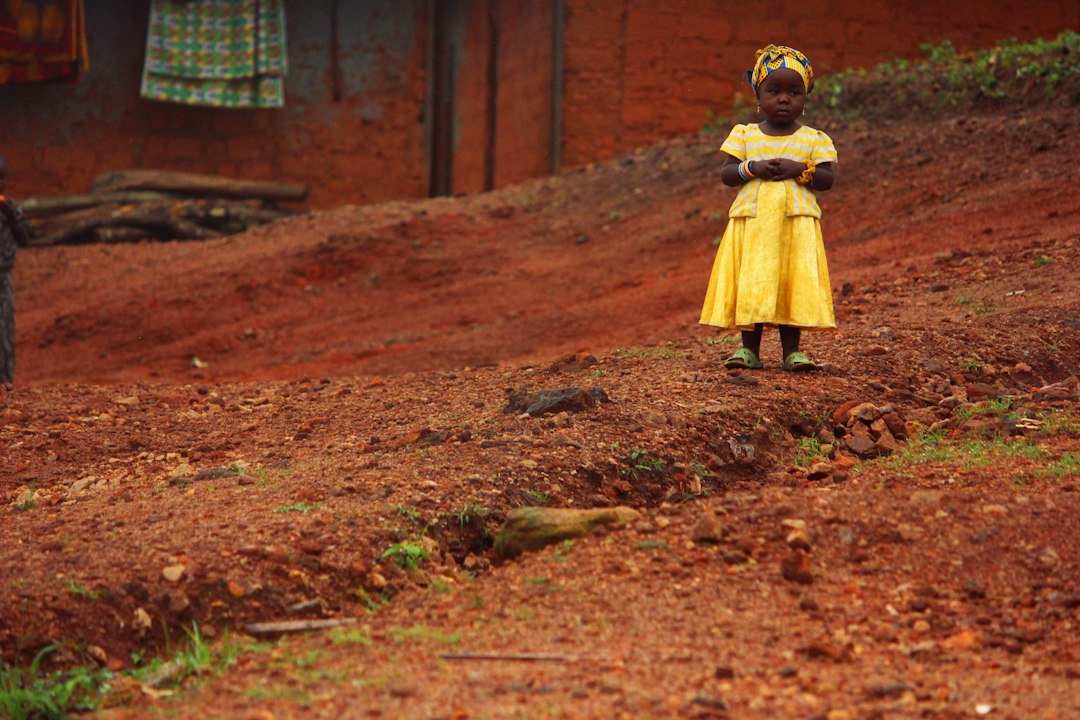
A girl, around six, hair braided into thin plaits tipped with tiny white beads, wearing a yellow dress washed nearly white. She didn’t speak. She looked up at Jiang Wan, gripping her hand hard—dry, burning hot.
From that song on, the hand never let go. When Jiang Wan couldn’t free both hands to hand out oranges, the girl switched to gripping one of her fingers. When Jiang Wan went to the tap to wash her hands, the girl followed, tiptoed, and tucked her freshly washed little hand back into Jiang Wan’s palm.
At lunch break, Mama Nema, the director, invited them to her office for tea. She was the kind of person who had stood straight her whole life, and she spoke slowly.
“At night… do the children miss their parents?” Jiang Wan chose her words carefully.
“Yes,” said Mama Nema. “Sometimes one starts crying, and the whole room follows. Just like you.”
Jiang Wan froze. “Like us?”
“A child is first a child,” Mama Nema said. “And only then, a child without a mother and father. What you saw this morning was the first one. What you’re asking about now is the second. Both are real. We live both.”
Jiang Wan lowered her head and looked at her own hands.
Lu Ze asked the question he’d been preparing the whole way: “If we want to come back next year, we need to know the real situation.”
Mama Nema looked at him for a moment, then rose and took a dog-eared notebook from the cabinet. Inside was a handwritten list: thirty-two children, nineteen iron-frame beds; the classroom’s back wall leaked in the rainy season; two of the older children had been admitted to secondary school, and their boarding fees were still unaccounted for.
“Why didn’t you say any of this before?” Jiang Wan asked. The moment the words left her mouth, she regretted it.
Mama Nema wasn’t offended. “People come here with ‘here’s what we’re giving,’” she said. “Very few come with ‘what do you need?’ You asked. So I told you.”
“But all we brought were pencils.”
“You also squatted down among them and sang songs all morning,” Mama Nema said. “Pencils run out. Hands don’t.”
When they left in the evening, the little girl walked Jiang Wan all the way to the gate. She pointed at Jiang Wan, then at herself, and said one word:
“Rafiki.”
“She means, friend,” Lu Ze said.
Jiang Wan repeated it, mangling the pronunciation, and the little girl giggled and corrected her, very sternly, three times. As the tin gate was about to close, Mama Nema stood in the doorway waving and taught them one last word:
“Here, we don’t say goodbye. We say Tutaonana. It means, we will meet again.”
3. “Photograph Me at the Sewing Machine”
Five days later, a tiny plane seating only twenty carried them to Kigoma, a quiet little town on the shore of Lake Tanganyika. The Women’s Support Center lay on the outskirts; before they’d even entered the courtyard, they heard the sewing machines—tat-tat, tat-tat—a dozen stitched together into one sound, like a rain that would never let up.
Rows of school uniforms hung drying in the yard, blue and white, pressed flat. A dozen young women sat at the machines, feet on the pedals, heads down. One of them carried a baby on her back in a printed-cloth sling, the baby fast asleep, bobbing gently to the rhythm of the machine.
Her name was Hawa. She was nineteen. The social worker, Zawadi, told her story in an offhand way: her husband had left; her family said she’d disgraced them and told her not to come back. She’d walked forty kilometers with her child in her arms, walked into this courtyard, and learned to run a sewing machine. Now, of everyone at the center, she made uniforms the fastest, with the tightest stitches.
Jiang Wan stood in front of Hawa’s machine for a long time. When Hawa worked the pedal, her hands would first smooth out the fabric’s turning points—quick, steady, not a centimeter of hesitation.
“How much is this dress?” Jiang Wan pointed at one and pulled out her wallet. “I’ll buy it. I can buy a few more, too.”
Zawadi translated. Hawa looked up, said a long string of something. Zawadi translated back: “She says, thank you. But please buy only the one you’ll actually wear. If you buy them to hang in a closet, she’d rather you not buy them at all.”
Jiang Wan’s face went red.
“I’m sorry,” she said. “I just thought… things must be hard for you.”
Hawa understood what that expression meant. She folded the dress and handed it over, then said another string of words, breaking into a laugh at the end.
“She says, yes, it’s hard,” Zawadi translated. “But hard is not all she is. It took her two months to learn the sewing machine. What she earns now pays for her daughter’s vaccines, and there’s some left over.”
Jiang Wan asked to take a photo. Hawa agreed, stood, straightened her collar—then said something else, very seriously.
“She says you can take the photo, but don’t photograph tears; she stopped crying long ago,” Zawadi translated, then paused. “Photograph her at the sewing machine. She says that is when she looks her best.”
When the shutter clicked, Hawa wasn’t looking at the camera. She was looking down at the cloth in her hands, one hand smoothing a turning point, her foot beating out tat-tat on the pedal, the baby asleep on her back.
As they were leaving, Hawa sent a question through Zawadi: “The girls from Beijing—what size dresses do they wear?”
Everyone froze, then called out sizes over each other, getting more and more chaotic, until they all burst out laughing. Hawa laughed the loudest. When she finished, she said: “If they like what I make, send word to me. Twenty dresses doesn’t scare me. I can make them.”
On the ride back, Lu Ze opened his notebook, crossed out the words “Aid List,” and wrote two words in their place: Orders.
4. “Why Learn Only That One Phrase”
Before leaving Kigoma, they visited a Maasai village. On the rust-red grassland, the acacias gathered their shadows close. Women sat in the shade stringing beads—red, blue, white—basket after basket of color, bright enough to dazzle.
Their guide said the girls of the village had attended a county “tourism services training course” and learned some English.
Jiang Wan, delighted, walked up to a girl holding a tray of bead strands. “Hello!”
The girl looked up. About seventeen, great beaded hoops swinging from her earlobes, eyes black and bright.
“Thank you,” she said.
“How are you?”
”…Thank you.”
Jiang Wan tried two more phrases; the girl just smiled and gave her the same answer. An older woman beside her came to her rescue, saying a long string of Maa. The guide translated: “She says, this one phrase is enough to make the guests happy.”
Walking back to the shade, Jiang Wan slowed down. She suddenly understood how that one English phrase had been learned. Not from a textbook. Not in a classroom. It had been spoken out, over and over, again and again, at tourists’ cameras and wallets.
As if they had been born owing the world nothing but thank you.
She sat down next to Nasilian—the seventeen-year-old—and through the guide asked a question: “Which phrase do you want to learn? You pick.”
Nasilian froze. She set the tray on her knees and thought for a long, long time, the wind making the beads chime softly.
“I want to learn to say,” she finally began, “‘This is my beadwork.’ And also, ‘The price is fixed.’”
Everyone laughed. She didn’t. She added, gravely:
“And also—‘The blue beads are not negotiable. I rode a whole day into town to buy the blue beads.’”
That afternoon, in the acacia shade, there was a halting, off-key English lesson. Jiang Wan taught a sentence, Nasilian repeated it—slowly, but gripping every sound with her teeth. When they got to “the price is fixed,” the girls around them collapsed laughing. Nasilian didn’t laugh. She said those words mattered most.
In exchange, Nasilian taught her the meanings of the bead colors: red for courage, white for peace, green for the land, blue for the sky, and for strength.
She picked white, blue, and red beads, strung a bracelet on the spot, and slipped it onto Jiang Wan’s wrist. The guide translated her words: “Peace, strength, courage. You have a very, very long flight.”
That bracelet, Jiang Wan never took off again—not for a single day.
5. “Be Like the Baobab”
The boat ride along Lake Tanganyika to Gombe Stream took an hour. The lake was too vast to seem like a lake; waves rolled in one after another, and sky and water blurred together into a single gray-green far away, like another sea. Fish leapt now and then at the bow, a flash of silver.
The forest of Gombe Stream pressed close against the shore, green going to black. In a clearing, from a distance, they saw chimpanzees: a mother sitting on the slope, unhurriedly grooming the infant in her lap with immense patience; another young chimp dangling upside down from a nearby tree, making mischief. Nobody spoke. Only the sound of shutters, very soft.
Dr. Collins had worked here for more than fifty years. He was in his seventies, thin, deeply sun-darkened, the cuffs of his white shirt rolled to his elbows. His handshake was strong.
“Go ahead,” he said, sitting down in the shade, getting straight to it. “Two weeks. What did you see?”
“Thirty-two children, nineteen beds,” said Lu Ze.
“A dress order nobody pitched—she raised it herself,” said Jiang Wan.
“Three English sentences a lot harder to pronounce than ‘thank you,’” said another member of the group.
Dr. Collins nodded and spoke slowly. “Good. You saw people, not scenery. Most people who come here see scenery.”
Lu Ze asked the question that had weighed on him the whole way: “Doctor, we’re only here for two weeks. Can something that short mean anything?”
The old man smiled, the lines at the corners of his eyes deep. “Jane planned to stay only two weeks when she first came here. That was sixty years ago.” He paused. “I’ve seen too many boats. They dock, they photograph, they’re moved, they leave. Kindness is like the rains—beautiful when it arrives, quick when it goes. And if a tree’s roots run shallow, one rain passes, and nothing is kept.”
He raised a hand toward the edge of the forest. “You see those baobabs? Six months of dry season without a drop of rain, and they’re still standing, still green. Why? They drank the entire rainy season into their bodies. Whatever you do, be like the baobab. Your rainy season is these two weeks. Go home and store it inside you, and sip it slowly.”
“Once it’s stored—then what?” Jiang Wan asked.
“The last time Jane saw me,” the old man’s voice slowed, “she said something she asked me to pass on to every young visitor. She said, ‘After I die, I’ll be watching you from above.’”
No one spoke. The wind roared through the canopy.
“Watching us do what?” Jiang Wan asked quietly.
“She wondered about that too,” Dr. Collins said, smiling. “Her answer was: whatever you like—everyone has their own path. But if you carry this place in your heart, remember what she spent her whole life saying: only if we understand can we care; only if we care will we act; only with action is there hope.”
On the ride back, the setting sun burned the whole lake copper. Jiang Wan leaned against the gunwale, Nasilian’s bracelet warm from the sun on her wrist. She thought: the word “you all”—that includes her too. A sixteen-year-old who would be back in Beijing in two weeks, back in classrooms and exam papers.
The words were heavy. And yet, strangely, she wasn’t afraid—she only felt held, gently, by something enormous.
6. “Will You Come Back?”
The day before leaving Tanzania, they went back to Sanganiva. No program this time, no cardboard boxes. Just to say goodbye.
Unexpectedly, the children began to sing first. When the intro played, Jiang Wan froze—it was “Song and Smile.” At some point, they had learned the entire song. Not understanding the words, they’d simply hauled them over syllable by syllable, singing it crooked and off-key with total confidence. When they reached “please take my song home with you,” every child in the dirt yard opened their arms toward them, like a field of sunflowers suddenly stirred by wind.
On the Chinese students’ side, there wasn’t a dry eye. Jiang Wan had started the song. She was also the first who could no longer sing it.
All the way to the bus, Amina held her hand. It was the tightest that little hand had gripped since that first morning. The driver was honking, the teachers counting heads, the luggage racks rattling.
Then Amina let go.
She released her hand, stepped back half a step, tilted her face up, and asked a question through the bus door. Her voice wasn’t loud, but every word was perfectly clear:
“Will you come back?”
Jiang Wan crouched down. She had prepared many answers; now she couldn’t remember a single one of them. Only one word came.
“Yes.”
“Asante,” said Amina. Thank you.
“No.” Jiang Wan’s tears fell, striking the ground between them. “It should be me saying asante.”
She remembered Mama Nema’s words, wrapped those two little hands in her own, and said, slowly, word by word:
“Tutaonana.”
“Tutaonana,” Amina repeated. She had known this word all along, and said it perfectly.
The bus drove far away, and Jiang Wan kept looking back. The yellow dress grew smaller in the rising dust, shrinking to a single bean. The hand was still waving.
On the plane, Lu Ze spread his notebook on the tray table and went through it item by item: beds, roof, school fees, dresses, sentences. He asked, “So what do we do when we get back?” Two weeks ago, he’d been the one to ask that question first.
“Now,” Jiang Wan said, “it’s finally our turn to figure out what to do.”
7. “Tutaonana”
The winter she got back to Beijing, Jiang Wan gave a presentation in the school auditorium. She had brought back more than two hundred photos; she showed only three. Not one of the three was meant to make anyone sad.
The first: Hawa’s back at the sewing machine, the pedal suspended at its highest point, the baby asleep on her back.
The second: the children singing in the dirt yard, every face tilted upward. She could finally prove with a photograph what she’d known that day—every one of those children really was glowing.
The third: a small cardboard sign standing at Nasilian’s bead stall. The English sentences on it were ones she’d chosen herself; Jiang Wan had only written them down for her:
“These are my beadwork. The price is fixed. The blue beads come from far away.”
The auditorium was silent. Jiang Wan said: When we set out, we thought we were going there to deliver light. Only later did we understand—the light was always on them. It never needed delivering. What we could really do was see, remember, and then come home and turn the word “care” into a verb.
That winter, they did a few things. None of them big.
The thirteen iron-frame beds were not shipped from China—Mama Nema said the carpenter in town could make them just as well, and the money should stay in town. The beds were finished in March. Mama Nema sent a voice message, the background a happy chaos: “The children circled the new beds tonight and counted them. Three times. Even the wood smells sweet.”
Before the rains came, the classroom’s back wall was mended.
The forty dresses were a real order. Classmates pooled money to order New Year gifts; Zawadi quoted Hawa’s price for her, and wouldn’t shave off a cent. Someone joked about haggling for a discount. Zawadi replied: “Hawa says, the price is fixed.” Everyone laughed and paid in full.
Late on the last night of winter break, the video call connected. The signal was bad, the picture freezing frame by frame. Mama Nema held up the phone, a crowd pressing behind her, small faces popping into the lens one after another, until a small hand pushed them all aside—Amina, a little taller, still in that yellow dress, the white beads on her braids brand new.
Zawadi translated from the side: “She asks, will you come back?”
“Yes,” Jiang Wan said to the camera. “Next July. I’ve been checking flight prices all semester.”
“Asante!” the small voice shouted from the screen.
“My turn,” Jiang Wan laughed. “Tutaonana.”
“Tutaonana!”
The signal cut out, and the screen went dark. Jiang Wan sat in the dark a while without turning on the light. The night sky outside was an uncommonly clear Beijing winter night, one star very bright. She thought: Jane Goodall said she would be watching from above after she died. That must be a very long time from now—long enough for many people to turn many words into many things.
Her mother pushed the door open, set down a cup of warm milk, and glanced at the dark screen. “Still going?”
“Going,” Jiang Wan said. She thought for a moment, then added, “Mom, you know what? In their language, the word for ‘goodbye’ means—we will meet again.”
She thought of the baobab trees lining the inland highways of Tanzania. They hid an entire rainy season inside their bodies, and so they stood straight even through the dry season, roots reaching for the sky, waiting for the rain to come back.
The rain will surely come back.
As long as the trees keep standing there, keep standing toward it.
(This story is based on real events; all names are pseudonyms.)
Based on a true story