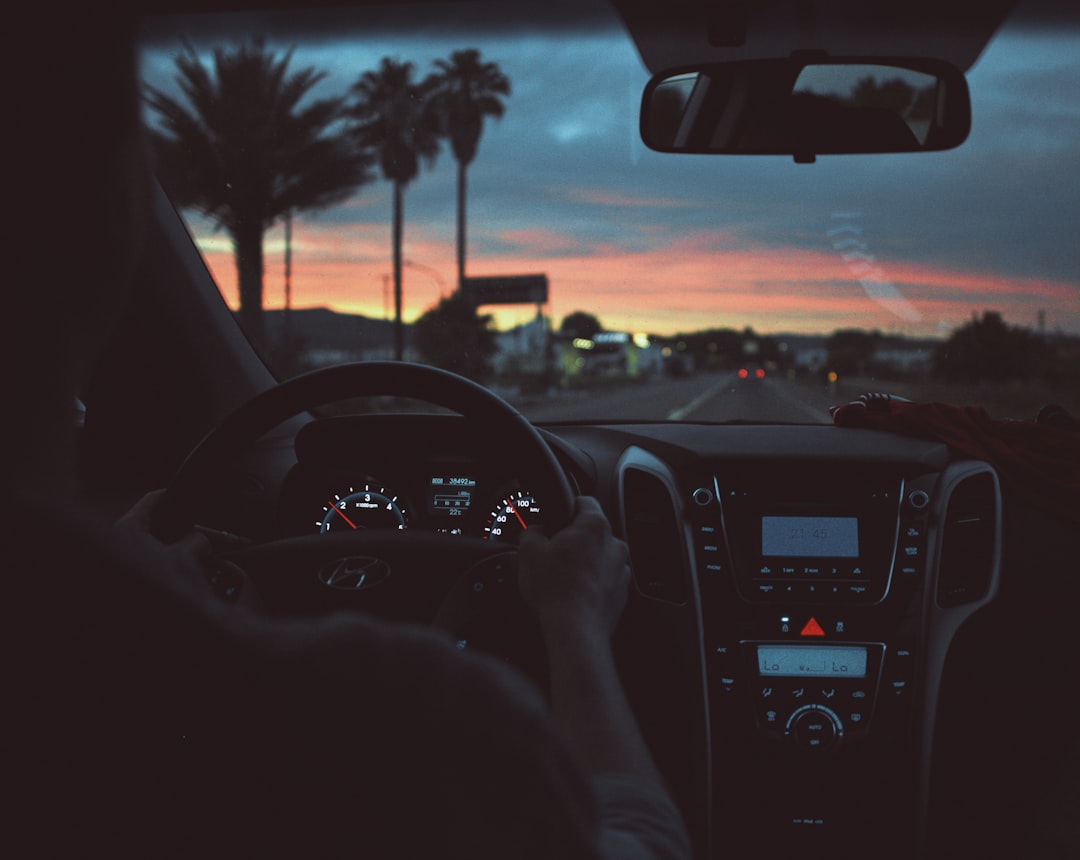
Night Crossing
“Sir, did we just miss the turn?”
Jiang Ye asked twice. The first time, the man in the driver’s seat didn’t answer; the second time, Old Lu gave a low grunt, his eyes taking forever to turn.
*
August the fourth, night. Yixing to Suzhou, over a hundred li. Jiang Ye was riding in Old Lu’s car, hitching a ride back to school.
When he got in, the two of them were still chatting and laughing. Old Lu was in his early fifties, three years driving ride-shares. He said his son was away at college, said he’d bought this car just two years ago, said the work was hard but free. He handed Jiang Ye a bottle of water and asked whether the school was far, whether he’d come home for holidays.
Halfway there, the talk thinned out.
Old Lu reached to tap his phone. His finger hovered over the screen, came down—missed. Came down again—missed again. He murmured: I’m a little dizzy.
Night road, a tired man. Jiang Ye thought so too, at first.
*
Ten minutes after crossing into Suzhou, the car drifted five times.
Once. Twice. Three times. The wheels gnawed onto the road shoulder, the car gave a little hop, like a boat’s hull scraping a reef.
The fifth time, Jiang Ye sat up straight.
“Sir, pull over.”
“It’s nothing, let me just—”
“Sir, pull over.”
The third “pull over” left no room for negotiation.
*
The car pulled over. Jiang Ye did two things first: kill the engine, pull the handbrake. The third: he took out his phone and dialed 120. The dispatcher confirmed the intersection and said: don’t hang up.
So he didn’t.
Moving a person isn’t in any book of heroic deeds—it’s in Driver’s Ed course two. He’d only gotten his license that March, and his instructor, dead serious, had taught him: secure the car first, then everything else. Moving a person by yourself is far harder than you’d think. Six or seven minutes—over he went, propped him up, buckled the seatbelt. As it clicked, Old Lu mumbled something he couldn’t make out.
He never asked about it later. Some words belong to the sick man alone.
*
In the driver’s seat, a different man sat.
Old Lu, eyes half open, made out one clear shape through the fog: the boy gripping the wheel with both hands, knuckles gone white. He wanted to say, “Take it slow,” but his tongue wouldn’t obey; the words fell apart at his lips.
Jiang Ye was running the checklist in his head. Lights. Horn. Slow. The instructor’s words passed one by one, like counting prayer beads in the dead of night.
*
Thirty kilometers, night road.
The car was a stranger to him. The turn signal stalk worked differently from his instructor’s car; it took him three tries to find the horn. Trucks loomed in the rearview mirror, headlights white as a wall. One place he crossed over the solid line; another place, crossed again. Looking back afterward, he realized the sweat from his palms had soaked two patches into the wheel.
The phone lay on his leg, speaker on. The voice on the other end had little to say the whole way, just a crackling hiss—as if someone were keeping him company.
The navigation was useless in this car, so he called out each intersection one by one, like a night watchman. After every one, he’d murmur: Sir? Whether Old Lu answered, he didn’t dare press—only slowed down another notch.
*
The hospital lights grew out of a sheet of darkness.
He handed Old Lu over to the ER with just one sentence: Sir, we’re here.
How the man was wheeled away, how the doors closed—he couldn’t quite remember. A night that long, when you reach the end of it, the last few steps often vanish.
Only when he stood in the corridor did he discover his legs had gone soft.
*
The doctor’s words reached him later: cerebral infarction. One step later, the man might not have been saved; and even saved, the rest of his life might not have been his own to command.
Thirteen days.
Thirteen days is a thin page on a calendar, and a stretch of dark water of unknowable depth on a hospital bed. Old Lu waded through it, inch by inch. When he struggled ashore, his first question was: that boy—what’s his name?
*
For that trip’s fare, Old Lu had his family return the money. Jiang Ye couldn’t refuse, so he took it, and said:
“Sir, once you’re back on your feet, you can drive me again.”
*
In September, the story got its ending: Jiang Ye was officially commended for courageous action.
Someone asked him: five months with a license, less than two hundred kilometers of driving—how did you dare, that night?
He scratched his head.
“I happened to have a license,” he said. “I could help, so I helped.”
“Weren’t you scared?”
“Scared. My hands shook the whole time.”
“Shaking—how did you still drive?”
He paused, as if walking through the answer once more in his mind:
“A car can’t be left stopped in the middle of the road.”
*
His mother heard about it from someone else. She barely slept that night, and the next day said only this: from now on, when something happens, get the car stopped steady first—then talk.
Jiang Ye agreed.
What he didn’t say was: that night, it was precisely because he’d first stopped the car steady that he could speak at all.
*
Afterward, there was nothing heart-stopping left. Jiang Ye went to class as before; Old Lu drove as before—except at intersections, both of them now slowed down a little more.
That night, the two of them rarely spoke of it again. The night was too dark, the road too long, the whole of it couldn’t be told—and didn’t need to be.
The night roads of Suzhou remember: there was no moon that night, but there was a car with its lights on, that carried a stranger from the middle of the water, steady and sure, all the way to the shore.
——
This story is adapted from a real event; all names are pseudonyms.
Based on a true story