The Wind Is Full of Fragrance
The mist hasn’t lifted yet when you arrive at the edge of the field.
You are seventy-nine this year, and the mountain has kept account of your years in your knees—every stretch of walking demands a pause. You crouch down. The dew is cold on your hands. A white chrysanthemum stands with its head raised, waiting for you, as if it has waited many years.
There is fragrance in the wind.
You walk along the raised path between the fields, the flowers on both sides stretching away into the mist. The young flower-pickers arrived early, bent at the waist, fingers rising and falling among the blossoms like a flock of birds catching fish in shallow water. They call to you through the fog: Grandpa, you’ve come. You answer, and your throat tightens. Such bright voices—how many years since you’ve heard them.
There was once fragrance in the wind too.
You remember that kind. On a misty morning just like this one, the mountain hollow was covered patch after patch with red and purple flowers, brighter than chrysanthemums, taller than chrysanthemums. When the wind blew, their sweetness was thick enough to smother, like fruit sealed in a jar. People from beyond the mountains came up carrying scales, and carried that fragrance down, sack by sack. That was when you were young. A long war raged outside, and your people had hidden deep in these mountains to survive. The land was good land—pity it was good in the wrong way—because that flower would grow only in such good soil.
At first no one paid it any mind. Then you noticed that no one threshed grain on the drying ground anymore, no one sang by the fire pit anymore. The young lay under the eaves, their eyes frighteningly bright, their arms too limp to lift a bucket of water. That fragrance had taken root in their bones, and could not be picked away. Some sold their cattle, some sold their silver ornaments, some sold their hope for tomorrow. The elders of the clan closed their eyes one by one, and every one of them looked at you before they did. You were the clan chief. In those days you felt like a wall left soggy by the rain.
There was no fragrance at all in the wind.
That was the year you turned seventy-one. You held no meeting, gave no speech. Before dawn, you walked alone to your own field, knelt down, seized the first flower with both hands, and pulled. The roots went deep, the ground was hard, and your hands shook—not entirely from age. You tore out one plant, then another, until dew and sweat soaked your clothes through. When the sun rose, a small patch lay flattened behind you. Your people stood on the field path watching. No one spoke, and no one walked away.
The next day, seven came. The day after, thirty. By the last day of pulling, the whole clan was in the fields. Even the most hopeless of the young men came, and he pulled the hardest—pulling one plant, crying out once—and no one laughed at him.
The hard part came after the flowers were gone. The land lay empty, and the people lay emptier still—emptier than the land. At night some tossed and turned until sweat printed their shapes into the straw mats; some stole down the mountain, then walked back on their own and stood at your door, not daring to knock. You built the fire pit high and bright, dug out the old songs the elders used to sing, one by one, and taught the women to sing them at the spinning wheel, taught the children to sing them herding cattle. To those who couldn’t sleep you said: Let it hurt. The hurt is the root working its way out. Once the root is gone, a person stands straight again.
That autumn, you divided the flower seeds passed down from the ancestors among the households. They were chrysanthemums—in the old ways, the flower for honoring ancestors and guests, a flower that never claims a field, blooming only in front of and behind the house. You said: The old ancestors left us their purest flower because they knew that one day we would need it.
There is the fragrance of tea in the wind.
The following autumn, the first harvest came in. You spread the petals in bamboo trays to dry, then stored them in jars. On the night of the winter solstice, the whole clan gathered around the fire pit. You took a handful of dried flowers and dropped them into the kettle; when the water boiled, the fragrance rose, and the whole room fell silent. You poured a bowl for everyone. That young man cradled his bowl, took a sip, then another, and suddenly wept. He said, Grandpa, it’s sweet. You said, Yes, it’s sweet. Our land could always grow sweetness. It was only left fallow too many years.
After that, the people who had gone down the mountain came back, one by one. Some had heard that the mountain flowers could be traded for salt and cloth; some came for no reason at all, only that they dreamed of the fire pit, dreamed of the songs. The first thing every returnee did was crouch in a field and take a handful of soil. As long as a hand is willing to touch the earth, there is still time.
The wind is full of fragrance.
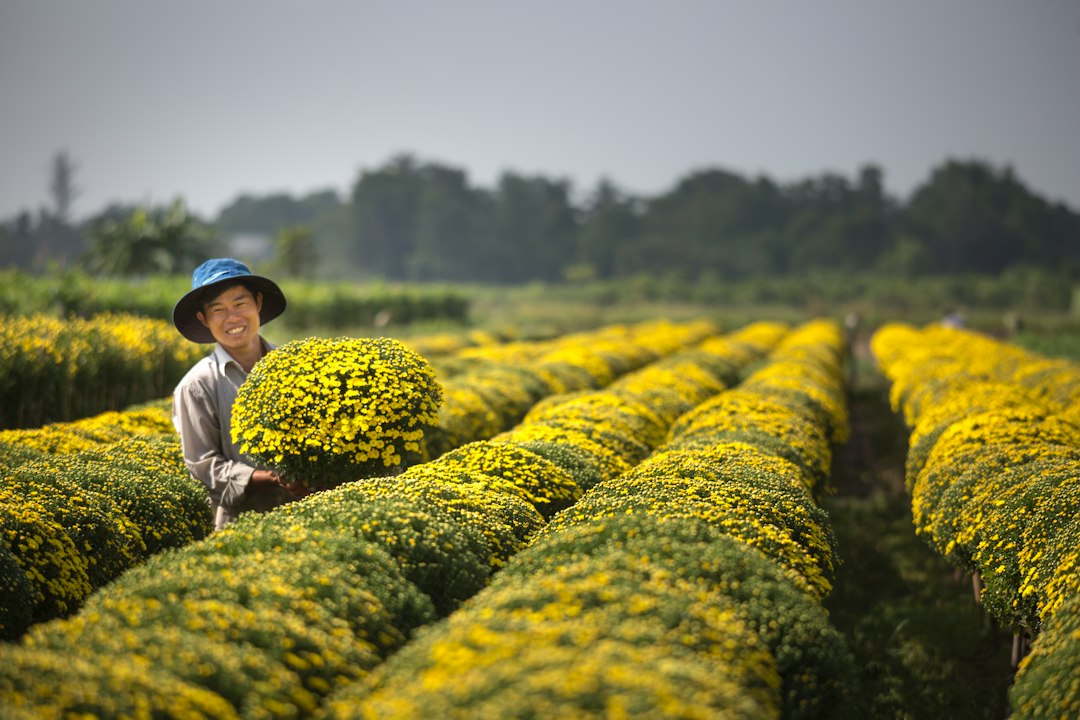
Now you crouch down again and pull the weeds beside that white chrysanthemum, your movements gentle, like tucking a blanket around someone sleeping. The mist has lifted; the sun falls on the flower fields, and the blossoms light up all together. A young man straightens up and calls: Grandpa, will you tell the story at Harvest Festival? You have your own festival now, the three days when the blooms are at their fullest—drying flowers, brewing tea, singing until the moon comes out. I’ll tell it, you say. Tell them why we plant flowers. A child of seven or eight comes running over, sets a freshly picked chrysanthemum in your palm, tips his head up and asks: Grandpa, didn’t they use to plant something else in these fields?
You lift him onto your knee and point down the mountain: That flower before made people sleep. This one wakes them up.
The child half understands. He tucks the flower into your collar. You sit in this field you pulled out stalk by stalk with your own hands, and planted again stalk by stalk—a flower at your collar, a child on your knee, the fragrance of brewing tea drifting over from the fire pit. You think: people are like flowers. As long as the root remains, willing to strike deep, there is no autumn that cannot be brought back.
The wind is full of fragrance. You close your eyes and breathe it in, deeply, deeply.
(The End)
This story is adapted from real events. All names are pseudonyms.
Based on a true story