Hold On · Chapter Thirteen: The Lights of This Street
The lights of this street come in three layers.
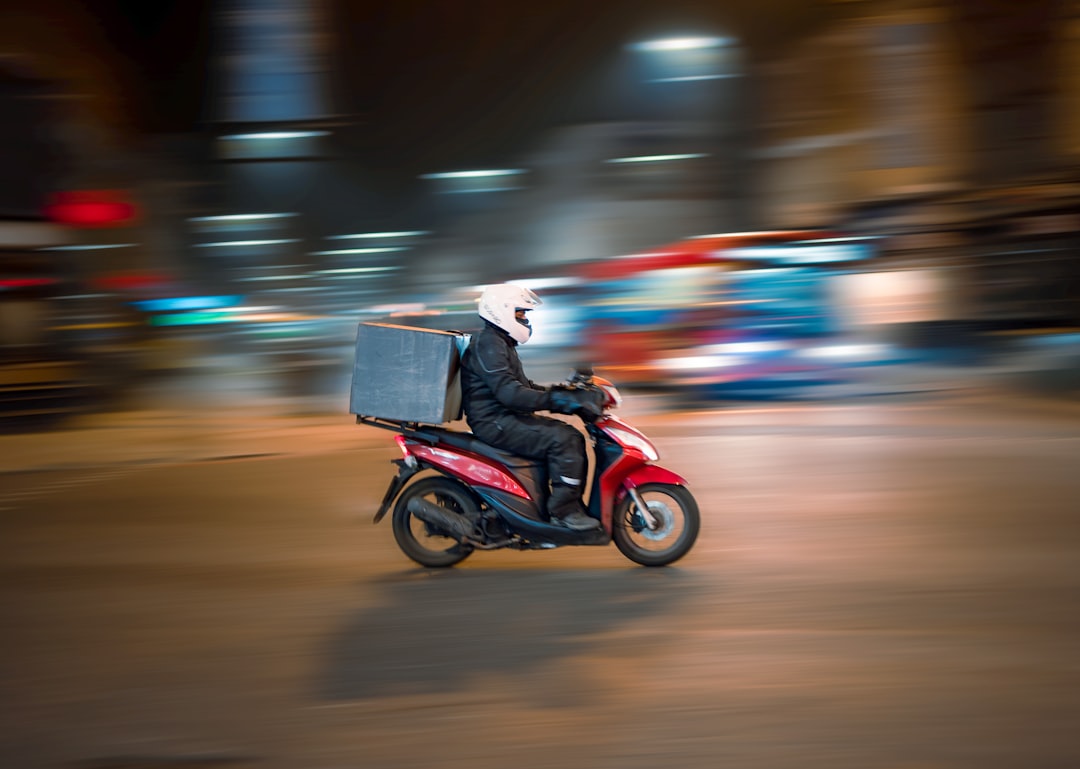
The lowest layer hugs the ground—the riders’ headlights, patches of blue and red that, in the small hours, run along the wet asphalt like two rivers. The middle layer is the lightbox of Uncle Kang’s burger shop, a warm yellow, the three characters for “Hold On Noodles” freshly repainted, the strokes thick, as if they’d been shouldered into place. The highest layer is at the far end of the street—the inpatient building of the city’s Number One Hospital, its whole facade a grid of white that never goes dark, even at three in the morning, as if someone had cut a slab of sky and stood it up there.
I had been running deliveries between these three layers of light for five months. Li Chaosheng, nineteen years old, last on the station’s roster. The guy ahead of me hadn’t survived the rainy season; when he left, he told me: this trade eats young lives. It’s not worth it.
I almost became the second one who wasn’t worth it.
The rain at the end of October, a slope, a manhole cover—my front wheel slid out half a meter. I was fine, but half the soup in my delivery box spilled. The complaint came that same night: soup spilled, bad attitude, refuses to answer the phone. What the platform docked me would have bought half a month’s worth of cigarettes—and I don’t even smoke. What I mean is, the number was small, but it could crush a man.
A pair of rain boots stopped in front of me.
“Can the bike still run?”
I looked up. Chen Dashan, thirty-five; everyone at the station called him Brother Ding—Hold-On. He had his own raincoat slung over his left shoulder and the lid of my delivery box in his right hand. Rain hung from his brow. He didn’t wipe it.
“It can.”
“Then get up.” He fastened the lid back on for me, pressed it down. “One more delivery. Follow me.”
The address was the hospital. A note in small characters: Elderly person waiting for medicine, please hurry. The rain was heavy; when his handlebar tilted a little, I knew it was time to turn. At the building he lifted a corner of his poncho: “Don’t put the pill box in the carrier—keep it inside your jacket. If the instructions get soaked and blur, and the old folks can’t read them, someone could get hurt.”
I did as he said. The pill box stayed warm against my chest the whole way. The old lady who opened the door insisted on pressing two tangerines into our hands, their peels still warm from her palms. Chen Dashan couldn’t refuse; he took them and gave me one on the way down, saying the only extra words of that night:
“Hold on.”
Two words, out of nowhere. But in five months of riding through rain, it was the first time I felt those two words weren’t a slogan—they were a thing handed to you. Once it’s in your hand, you have to catch it.
The station was quiet on Saturdays. Chen Dashan ran his route in the mornings as always, clocked out at two in the afternoon without fail, and went to wait at the school gate for Tiantian.
I’d seen Tiantian a few times. Eight years old, two little braids, a paint-chipped plastic pony hanging from her backpack. Her surgery had been six months ago—congenital heart disease—and the recovery went well; her checkups had gone from monthly to every three months, her numbers steadier each time. She’d announced an update to her wish list herself: it had changed from “I want to live” to “I want to run the 800 meters. Failing is okay. Passing is better.” After school she ran into the shop on her own, and Uncle Kang called out across the counter: The usual? She shouted: The usual! Not one egg less!
The soup at the “Hold On Noodles” window was Brother Ding’s recipe; Uncle Kang kept the stove. The window had become the street’s signature by now—generous with the beef, slice overlapping slice. Someone warned him about the cost; he wiped his apron and said: “Money saved on ingredients burns your hands.”
A new frame had gone up on the shop wall, holding a five-yuan tip receipt. Beside it, pressed under glass, was a note in ballpoint pen: I traded the cola for the big bottle. No need to pay me back—take care of yourself. Sister Zhao said the handwriting was the same hand that wrote “Hold On” on the lightbox. She laughed before she even finished saying it. Nobody in the shop ever called it out loud; it just hung there, like a bell that made no sound.
Wanqing came often on Saturdays, sitting by the window revising menus and lightbox designs, a bag of fruit candies sticking out of her backpack’s side pocket. She had low blood sugar; the candy was for others, and for herself. Once, when the platform wrongly deducted my pay and I was furious enough to curse the sky, she handed me a candy and passed along her father’s words:
“When my dad was in the hospital, he told me that accepting kindness is also a kind of kindness. I didn’t believe it then. I do now. Anyone can tough it out—it takes real skill to be able to receive.”
The one who taught me the trade at the station was Sister Zhao, forty, the most senior of us all. Her first lesson was wrapping your phone in plastic film: “Your hands are worth more than your phone. If the phone gets wet, worst case the screen goes black. If your hands crack, what are you going to grip the handlebars with in winter?” She had a knife of a mouth, said us soft-skinned kids would blow away in the wind—then turned around and stuffed the rain pants I’d left behind into my box.
Xiaofei’s account was called “The Light on the Corner.” He stopped filming himself and filmed only this street: the soy-milk couple setting up their stall at four in the morning, the row of shared umbrellas outside the hospital, Brother Ding steadying a vegetable vendor’s toppled tricycle in the rain, crouching to help gather up the scattered beans. Over three hundred thousand followers. One comment was pinned to the top: Scrolled onto this in the middle of the night, and suddenly felt—there are people in this city looking out for you. Xiaofei screenshotted it. He said he used to film the spectacle; now he filmed people.
Station Chief Zhou had set up a cabinet at the station entrance called the Rider’s Rest Stop. The ginger soup was brewed by Uncle Kang and delivered over. Whoever was cold, drank. No ledger.
My own trial came in November.
My father fell from the scaffolding at his construction site. He came back alive—with a fractured heel. The doctor said three months of total rest, not a single movement. My mother’s voice on the phone was worn down, hoarse, and still laughing: “It’s fine. Your dad says it’s a good chance to rest.” I didn’t believe in “a good chance.” My father hadn’t rested a single day in his life.
I ran the numbers: rent, the bus ticket home, the money to send back. Minus the deductions for two late deliveries. That night after my shift, I sat in front of Uncle Kang’s shop counting coins, one by one, very slowly, as if afraid of miscounting someone.
The rolling shutter rattled. Uncle Kang was closing up. He saw me, said nothing, went back inside. A few minutes later he came out with a bowl of noodles, two eggs poached in it, the beef as generous as ever.
“Employee price,” he said.
“I’m not your employee.”
“All the new ones count.” He slapped the chopsticks into my hand. “My first year after being laid off, I sold noodles from a street stall. I had it worse than you. Eat.”
The noodles were very salty. Or maybe that wasn’t the noodles.
When I finished and went to wash the bowl, he shooed me out: “Employees don’t wash dishes.” At the corner I glanced back: under the lightbox, he was on tiptoe, wiping the three characters of “Hold On.” A fifty-two-year-old man; he wobbled on his tiptoes, steadied himself on the wall, and kept wiping.
My master taught me two rules—not for deliveries, but for stocking up.
The first: “Keep two candies in your bag. That’s our trade’s rule. You never know who, at what moment, is about to break.”
The second: “When you meet someone in a hurry, loosen a bottle cap half a turn before screwing it back. You never know if the hands receiving it will shake.”
I kept these two rules alongside the plastic film and the rain covers.
One凌晨 in November—or rather, one dawn in November, after my last delivery at the ER entrance, I saw a nurse crouching on the steps, just off the night shift, her face as pale as the hospital building itself, her hands shaking too badly to hold her phone. I propped up my bike, fished the two candies out of my bag, set them beside her, said nothing, and left.
Half a block out, I looked back. She had closed the candies into her palm and nodded once, in my direction.
I don’t know whether she ate them later. My master was right: the candy is there, not for show.
December’s first rainy night, ten forty in the evening. Two more orders and I could call it a day.
The system assigned me one: an old residential block behind the hospital, the note written in cramped characters, as if typed while walking: “Please prioritize—elderly at home waiting for dinner. I’m heading back from overtime. Sorry to trouble you, driver.” Two kilometers. Rain. Late-delivery risk flagged red.
Five months ago, I probably would have hit “transfer order.” Not out of cruelty—out of having nothing left to give. A person’s kindness is like a pocket: when it’s empty, there’s nothing to spare.
I accepted.
Before clocking off I passed the convenience store. In the warming case sat the last bottle of hot cocoa. I bought it, loosened the cap half a turn, screwed it back, leaving just that bit of give, and tucked it into the bag’s side pocket.
The rain was fine and dense. My headlight pushed the street’s lowest layer of light forward. Uncle Kang’s lightbox was still glowing; Tiantian’s little pony bobbed up and down on her backpack as she headed home; the hospital’s white grid of a building stood in the rain like a slab of frosted sky. I parked below the apartment building—one stairwell light was out—switched on my phone’s flashlight, and climbed two floors, keeping my footsteps as light as I could. The person who wrote the note was still on the way home from overtime; inside, perhaps, an old man had only just closed his eyes.
I stood at the door and heard the shuffle of slippers against the floor, far away, then nearer.
I freed up my hands, straightened up, raised my fist—and it hadn’t yet come down.
The rain had chased me the whole way here, but it hadn’t followed me in. This street’s lights come in three layers, and the lowest layer—tonight—it was my turn to shine.
(The End)
Adapted from true events. All names are pseudonyms.
Based on a true story